| Coming Fall/Winter of 2026!
Mike Sullivan vs. Tim Martin Formal Debate
Moderator: To Be Announced
Date and Time: To Be Announced
Hello Friends,
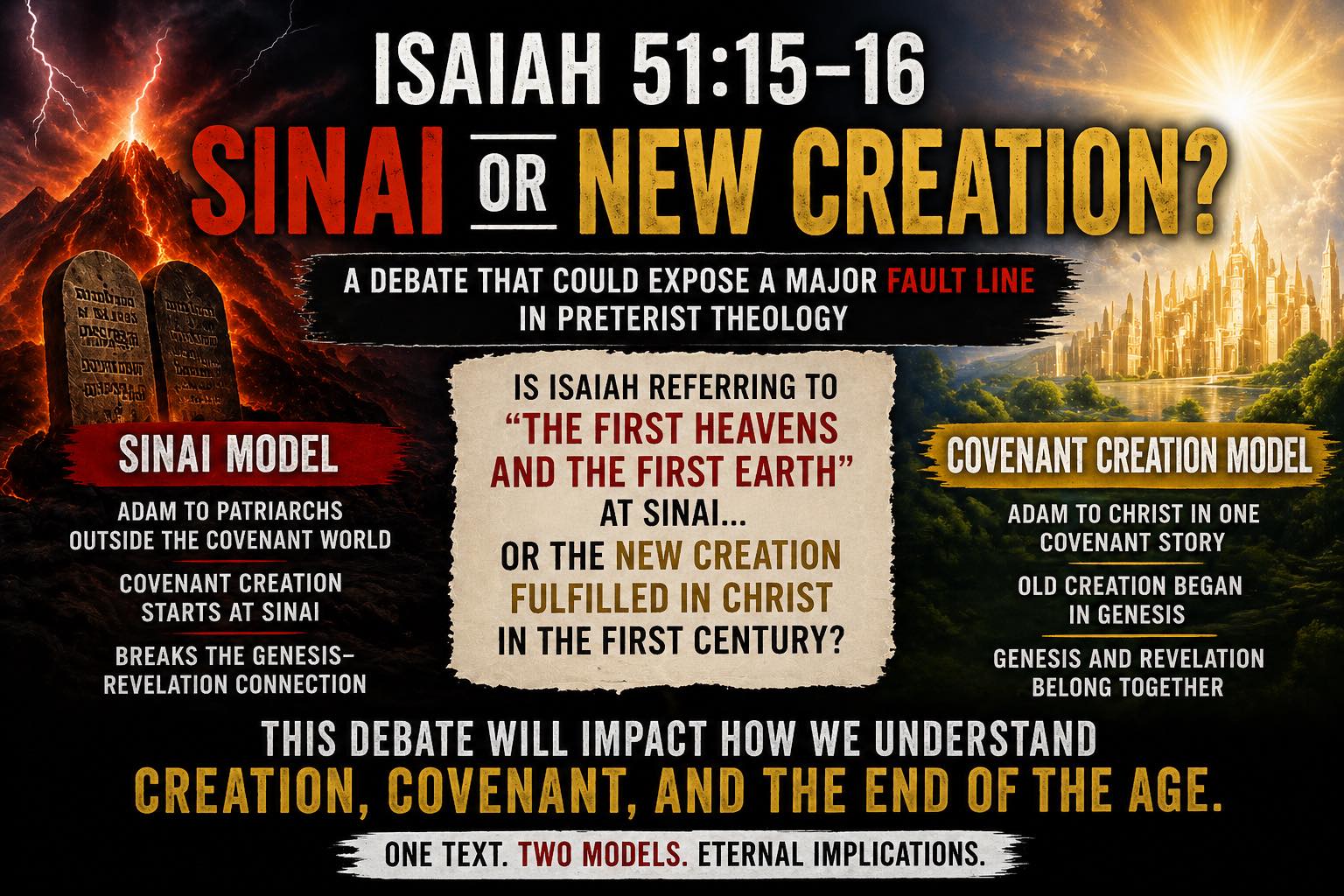
I am very pleased to announce an upcoming formal debate between Mike Sullivan and Tim Martin regarding Isaiah 51:15-16!
This is a crucial text for preterist theological clarity and, I am convinced, Genesis Creation studies.
Tim Martin challenged Mike Sullivan regarding his view that Isaiah 51:15-16 refers to Sinai events as the creation of 'heavens and earth' in past history (from Isaiah's perspective). Tim Martin will take the position that Isaiah 51:15-16 looks forward (from Isaiah's perspective) to the New Creation People of God, the New Heavens and New Earth to be fulfilled in the first century.
The Question At Hand
"Does Isaiah 51:15-16 describe the first or second Exodus heavens and earth?"
"15 But I am the Lord thy God, that divided the sea, whose waves roared: The Lord of hosts is his name.16 And I have put my words in thy mouth, and I have covered thee in the shadow of mine hand, that I may plant the heavens, and lay the foundations of the earth, and say unto Zion, Thou art my people."
Isaiah 51:15-16 NKJ
I think you will be fascinated to see why Isaiah 51 is significant to understand in it's proper, prophetic context and meaning.
The title for this debate is simply:
"Isaiah 51:15-16: First or Second Exodus Heavens and Earth?"
Mike Sullivan will take the position that it refers to the First Exodus origin of "heavens and earth" in past covenant history with the Sinai event.
Tim Martin will take the position that it refers to the Second Exodus prophetic future of covenant history. The significant implication is the "heavens and earth" at the center of biblcal eschatology is the Genesis 1:1 "heavens and earth" created "in the beginning."
This upcoming 90-minute formal debate will offer an opportunity to resolve this disagreement, and it will have ramifications for understanding the whole context of creation and new creation in the Scriptures. Here is a link to the original FACEBOOK comment discussion on the Revelation Study Series which sparked the debate. Here is another link to more FACEBOOK comment discussion regarding the planning for the details of the debate. Both discussion comment threads provide backstory to what originally sparked this formal debate at the specific point of Revelation 21:1 in the Revelation Study Series.
A Necessary Retraction
The book Beyond Creation Science: New Covenant Creation from Genesis to Revelation (2001, 2005, 2007) by Tim Martin and Jeff Vaughn introduced Covenant Creation as a framework for the first time in print. At the time of the writing, Tim and Jeff held the Sinai view of Isaiah 51:15-16 as a result of Max King and Don Preston's influence and material. Here is a representative example from Don Preston from p. 172 his 2006 book The Elements Shall Melt With Fervent Heat on 2 Peter 3:
"God gave His word to Israel to establish their world. Their world was spoken of here as the heavens and earth. This is confirmed when Jehovah says He gave the Word to Israel, not only to establish the heavens and the earth but to make them His people. Isaiah places the establishing of the heavens and the earth, and entering into covenantal relationship as when God gave His law to Israel. This was at Sinai. Therefore, in the eyes of God and Israel, the heavens and earth were established at Sinai. Obviously not the physical creation, but the world of Israel."
More recently, Don Preston has issued something of a correction that seems curious in light of the ongoing Covenant Creation discussion. Don Preston now says that the focus and context of biblical eschatology is wider than Israel only, and that he did not properly emphasize this wider context in the past. This video clip is dated May 13, 2025, leading up to preparation for his presentations at the 2025 Montana Conference - "The Eschatology of Genesis." Preston's conference presentations were titled "The Restoration of All Things."
See that Video Clip here.
A couple of citations from Don Preston will illustrate the importance of this concession, even if the implications have not been developed fully as of now:
First and foremost is the undeniable fact that Paul, when considering the resurrection from the death of Adam, posited that resurrection as the fulfillment of God's promises to Old Covenant Israel. He directly cites Isaiah 25 and Hosea 13, not to mention the fact that he indirectly alludes to Daniel 9, Daniel 12, the Psalms and other O.T. prophecies (1 Corinthians 15:54-56). This means that the promise of resurrection made in the Garden is incorporated into YHVH's promises to Old Covenant Israel. So, the story of the Garden becomes the story of Israel."
--Don K. Preston, We Shall Meet Him in the Air: The Wedding of The King of Kings, p. 4.
And:
It all goes back to the Garden and God's promise there (Genesis 3:15), which was reiterated to Abraham, and carried through Israel, to restore man to Him and give him etenal life. As we suggested at the outset of this work, we must see Thessalonians within the context of the restoration of the life lost in the Garden."
--Don K. Preston, We Shall Meet Him in the Air: The Wedding of The King of Kings, p. 101.
If the covenant promises given to Adam and Eve in Genesis 3 are "reiterated" to Abraham or "incorporated" into the covenant promises given to Israel later, then how could Adam, Abel, Noah, Abraham and the Patriarchs exist under a different "Heavens and Earth" than Moses and Israel post-Sinai? What was their covenant consummation before Sinai?
Here is a crucial question to ponder:
Were the covenant promises of resurrection transferred from one "Heavens and Earth" to the next "Heavens and Earth" in covenant history? What implications would that have for the eschatological doctrine of resurrection promised to Old Covenant Israel? Futurism essentially claims the promises of resurrection given to Israel remain in our future, precisely because they have been transferred from Old Covenant Israel to the Church to be fulfilled at the end of history!!!
Does Don Preston's and Mike Sullivan's view of Isaiah 51:15-16 (Sinai as a new "heavens and earth" creation) provide THE precedent an foundation for the covenant promises of resurrection given to Old Covenant Israel to be transferred to the New Heaven and New Earth of the Church, to remain a future promise in some future sense even now (perhaps 2 senses)? If the promise of the resurrection given in the Garden (Genesis 3) can be (and indeed was!) transferred to Israel's later "heavens and earth" created at Sinai, then the biblical precedent has been established for the promise of Resurrection to be transferred to later "heaven and earth" creations!!! Why would this not establish the biblical pattern for the resurreciton promise to be transferred from Old Covenant Israel to the Church to be fulfilled at some proposed "end of history"?
Transferring covenant promises from one "Heavens and Earth" to the next "Heavens and Earth" could potentially have fatal implications for the whole theological paradigm known as Covenant Eschatology!
Have questions and issues like this even been considered?
Tim Martin will press them in this upcoming, public formal debate.
On the other lhand, if these aspects in covenant history are all covenantally united (as the Preston citations above demonstrate clearly), then wouldn't it make more sense to view them all as different eras under the over-arching singular Old Covenant "Heavens and Earth" administration, inaugurated with Genesis Creation and Adam "in the beginning"? That is the Covenant Creation view suggested by Milton Terry back in 1898 and developed as a framework and theological paradigm in print with Beyond Creation Science. This will be the view Tim Martin defends in the upcoming public debate with Mike Sullivan.
Regardless of the questions for Don Preston and Mike Sullivan to resolve, Tim Martin now publicly retracts the claims made on pages 76 and 328 of BCS regarding this Sinai view in light further reflection and the upcoming formal debate with Mike Sullivan. Continued study has revealed a deeper understanding of the text as prophetic, looking forward to the first century new creation of God's covenant people in Christ, paralleling Psalm 102, Isaiah 65 and 66, Jeremiah 31, Hosea 2:18, etc. This suggests that there are 2 biblical "heavens and earth" in the biblical narrative: The "in the beginning" heavens and earth of Genesis 1:1, the Old Covenant Creation, and the New Covenant Creation heaven and earth referenced in passages such as Revelation 21:1, 2 Peter 3, Hebrews 12, etc. There is the "first" heavens and earth (Old Covenant), there is the "second" heaven and earth (New Covenant). The Old Covenant is the Natural, and the New Covenant is the the Spiritual (1 Corinthians 15).
Three important developments led to this transition on Isaiah 51:15-16 for Tim Martin and Jeff Vaughn:
First of all, Jack Scott challenged us on our Sinai view of Isaiah 51:15-16 around the time of publication of the 3rd edition (2007) of BCS, but we did not embrace his suggestion that Isaiah 51:15-16 looks forward to the prophetic future of the New Creation, the New Heavens and New Earth. We remained convinced of Preston's model (also presented by Max King in The Cross and the Parousia of Christ). We now realize, and have for many years, that Jack Scott had it right all along. We should have listened closer to his explanation.
The second was this 2009 article on 2 Peter 3 by Jerel Kratt titled "The 'then world' verses the 'now heavens and earth' in 2 Peter 3:6-7." Especially revealing is footnote #7 in that article. I do expect 2 Peter 3 will be relevant to this upcoming formal debate.
The third development was the 2013 publication of the full preterist book titled "Christian Hope Through Fulfilled Prophecy" by Charles S. Meek with a foreword by David Green. Here is how Isaiah 51 is presented in that book on pp. 131-132:
"This passage is clearly covenantal ('You are my people.') Further confirmation comes from Isaiah 51 being sandwiched within four Messianic 'Servant Songs': Isaiah 42:1-9; 49:1-7; 50:4-11, and 52:13-53:12. The preterist interpretation is consistent with other passages we have already considered from the New Testament, and thus we think Isaiah 51 looks forward to Christ's first and second advents in the first century."
We could represent this view with the following diagram, based on the diagrams in Meek's book on pp. 325-328 in Appendix B titled "A Tale of Two Ages:
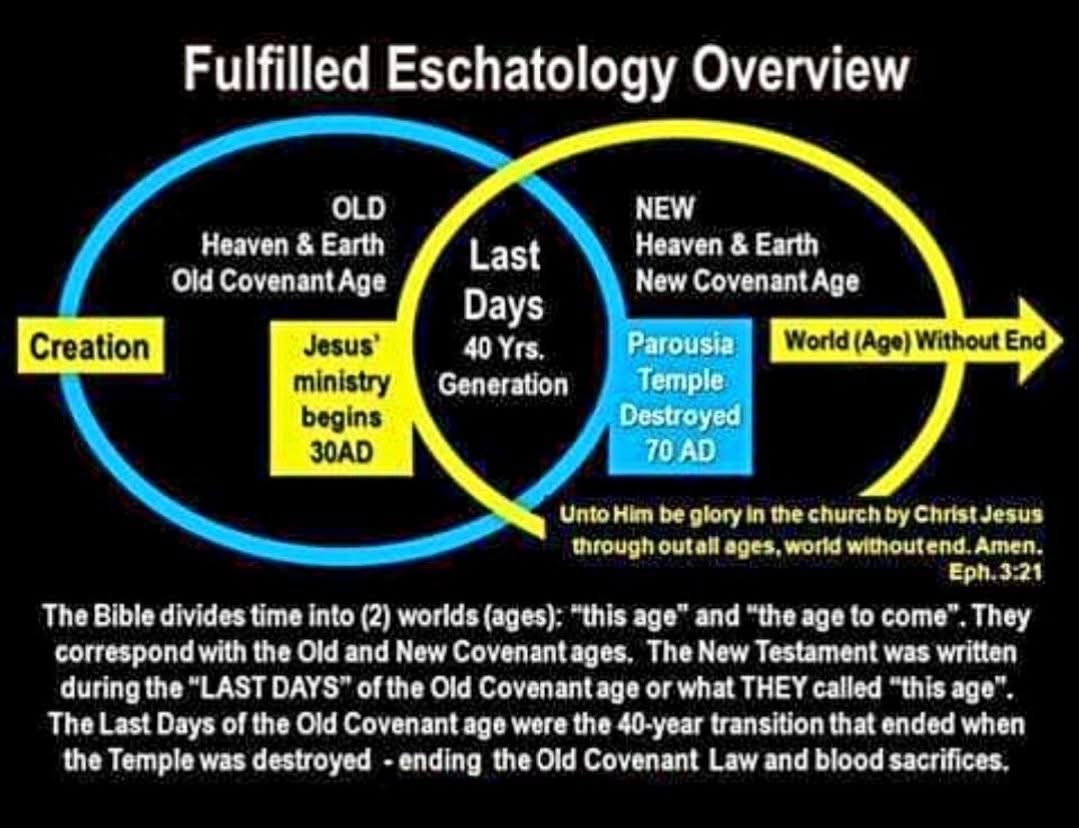
Tim Martin will defend this published Full Preterist view in the upcoming formal debate with Mike Sullivan.
The graph offers prima facia evidence that the Old Covenant Age cannot be bifurcated from the Old Covenant Creation. Adam is the "First Man" (1 Corinthians 15:45) in the "First Heaven and First Earth" (Revelation 21:1) which passed away entirely by AD 70. Adam is the covenant head of the Old Covenant people of God. (See The End of the Adamic Age video by Tim Martin for further development and theological implications.)
Also note how older Old Testament scholarship from the 1860s -- which predates the rise of Dispensationalism -- also properly interprets Isaiah 51:15-16 as forward looking to the New Creation. This citation is from the Keil-Delitzsch Commentary of the Old Testament (Vol. 7) pp. 290-291 (1862):
"The promise, as pledged which Jehovah has staked His absolute power, to which everything must yield, now rises up to an eschatological height, from which the historical point at which it began. Ver. 16. 'AND I PUT MY WORDS INTO THY MOUTH, AND IN THE SHADOW OF MY HAND HAVE I COVERED THEE, TO PLANT HEAVENS, AND TO FOUND AN EARTH, AND TO SAY TO ZION, THOU ART MY PEOPLE.
It is a lofty calling, a glorious future, for the preparation and introduction of which Israel, although fallen as low as ver. 7 describes, has been equipped and kept in the shadow of unapproachable omnipotence. Jehovah has put His words into the mouth of this Israel -- His word, the force and certainty of which are measured by His all-determining absoluteness. And what an exalted calling which it is to subserve through the medium of these words, and for which it is preserved, without previously, or indeed at any time, passing away? We must not render it, 'that thou mayest plant,' etc. with which the conclusion does not harmonize, viz. 'that thou mayest say' etc.; for it is not Israel who says this to Israel, but Jehovah says it to Israel. The planter, founder, speaker, is therefore Jehovah. It is God's own work, to which Israel is merely instrumentally subservient, by means of the words of God placed in its mouth, viz. the new creation of the world, the restoration of Israel to favor; both of them, the former as well as the latter, regalia, of God.
The reference is to the last times. The Targum explains it thus: 'to restore the people of whom it is said, They will be as numerous as the stars of heaven; and to perfect the church, of which it is said, They will be as numerous as the dust of the earth.' Knobel understands by this a completion of the theocracy, and a new arrangement of the condition of the world; Ewald, a new spiritual creation, of which the liberation of Israel is the first corner-stone.
But the prophecy speaks of a new heaven and a new earth, in something more than a figurative sense, as a new creation of God (ch. lxv [65]:17). Jehovah intends to create a new world of righteousness and salvation, and practically to acknowledge Zion as His people."
Tim Martin will defend this 19th century evangelical view of Isaiah 51:15-16 within a Full Preterist context.
The 2008 Sam Frost vs. Martin/Vaughn Debate Context
What makes this upcoming debate fascinating is that Mike Sullivan will defend key elements of the old theological framework and paradigm Sam Frost used in the very first formal debate over Covenant Creation in 2008.
Note how Mike Sullivan is in full agreement with the Sam Frost of 2008:
"The Temple in Jerusalem is explcitly called 'the first tabernacle' as it is related to the ''first covenant'. Its demise would be a destruction by fire -- a destruction of 'heavens and earth,' covenantally speaking. It is this 'first heavens and first earth' that John saw as 'passing away.'
-Sam Frost, Sam Frost vs. Martin/Vaughn Debate of 2008
"This [Sinai Creation] is the 'first heavens and the first earth' that I believe is going to be destroyed in Revelation 21."
-Mike Sullivan, at 27:27 in this Revelation Study Series Episode
Now that Mike Sullivan has declared his theological agreement with Sam Frost from 2008, the entire 2008 Frost v Martin/Vaughn debate becomes relevant to this upcoming Sullivan v Martin debate. In fact, this will be, in some respects, a repeat debate regarding the aspects Sam Frost argued regarding Sinai.
Mike Sullivan will be defending key elements of Sam Frost's model in this diagram:
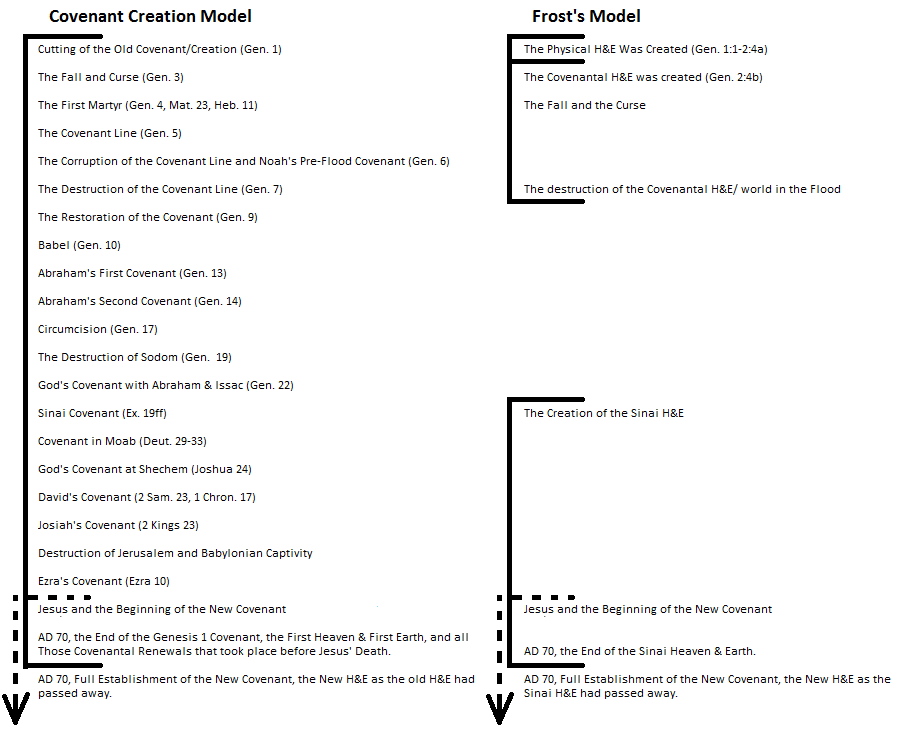
The 2008 Frost v Martin/Vaughn debate will likely be instructive for what will take place in the upcoming Sullivan v Martin debate. I expect Mike Sullivan to repeat and duplicate many aguments that Sam Frost made back in 2008. You can examine the full written 2008 debate on the Beyond Creation Science website here.
Relevant Study Material for Preparation
Those who wish to study some backstory and related material in preparation for this upcoming debate can follow the links below. Preparation study will reveal the profound significance for this upcoming Sullivan v Martin debate on Isaiah 51:15-16.
Mike Sullivan Recommends These Resources:
More Links and Content to be added soon!
Tim Martin Recommends These Resources:
1) Temple Theology and Imagery of Genesis 1-4 to Revelation 21-22 -- The Cosmology of Israel's Covenant, Land and Temple Promises Fulfilled in AD 70 and Within the New Covenant "Age Without End" by Mike Sullivan
Tim Martin highly, highly, HIGHLY, recommends this (2008) work by Mike Sullivan.
Tim Martin will attempt to prove his case in the formal debate directly from Mike Sullivan's own published work.
2) Mike Sullivan's new book titled Moses to Messiah: Deuteronomy 32 The Song that Shook Israel's Last Days Terminal Generation.
The details in this book lay out Mike's view of Isaiah 51:15-16 on pp. 29-31. However, what is most intriguing is what Mike Sullivan concedes on p. 8 - That Jacob taught Israel's eschatology in Genesis, long before Sinai!!! Consider these citations:
"Moses' prophecy of Israel's 'last days' outlines a period of covenantal corruption, culminating in the arrival of the Messiah, who WOULD FULFILL JACOB's ESCHATOLOGICAL VISION...
Moses has already recorded JACOB'S ESCHATOLOGY of what would happen to Israel in her 'last days' (Gen. 49:1ff). Notice that THESE ARE THE 'LAST DAYS' OF THE 'SONS OF JACOB' ....
JACOB'S ESCHATOLOGY primarily describes what will happen when Messiah comes....
The symbol of ISRAEL'S COVENANTAL ROYAL AUTHORITY was the temple, and when the temple fell, the scepter was taken."
Jacob also foretold that in Israel's last days, the Messiah would come from the line of Joseph"
-Mike Sullivan, Moses to Messiah (2025), pp. 8-9
If Jacob taught Israel's eschatology in the book of Genesis centuries before Sinai, then by what logical or theological basis can it be claimed that Sinai was the creation of the "heavens and earth" for biblical eschatology. Did Jacob speak about the eschatology of a "heavens and earth" which did not even exist when he lived? Are we to believe that Jacob spoke about the eschatology of a "heavens and earth" that had not even been created yet? This incoherence needs to be explained by Mike Sullivan (and those who hold this view including Don Preston), as to how Jacob could speak about the eschatology of the "heavens and earth" which didn't even exist in Jacob's time. Please make it make sense!!!
Furthermore, isn't Israel recognized as "God's People" in Egypt before the Exodus and Sinai events when Moses told Pharoah God's word to "Let MY PEOPLE go to hold a FEAST ..." (Exodus 5:1)? It seems not only that Israel existed as "My People" before Sinai, they also knew what a FEAST TO THE LORD was and how to observe a FEAST!!! Again, this is before the Exodus and Sinai. It should be interesting to consider that the term for "feasts of the Lord" is included in Genesis 1:14 related to Day 4, and referenced again in Jeremiah 31:35-36, also explicitly looking back to the Genesis 1 creation!
Does the biblical evidence, considered in the wider context and narrative flow, support the conclusion that Sinai was a creation of Israel and a new "heavens and earth"? Think of the implications of that doctrine. Does Noah, Abraham, Jacob, Joseph live in a different "heavens and earth" than Moses and post-Sinai Israel? (See Hebrews 11 and Matthew 23:34-35.
These questions will be pressed by Tim Martin in this upcoming, formal debate on the subject.
One particular curiosity to note about Mike Sullivan's book Moses to Messiah is that the book is focused on Deuteronomy 32, and yet has no discussion whatsoever of Deuteronomy 32:10-11 which uses explicit Genesis 1 language in the context of Israel's history! There are other obvious allusions to Genesis 1-3 in Deuteronomy 32 which receive no mention or discussion as well.
Tim Martin will show the profound significance of these Genesis creaiton elements of Deuteronomy 32 in this upcoming, formal debate.
3) Consider these two citations from "Moses to Messiah" just a few pages apart:
Isaiah emphsizes that God "made" or "established" Israel as a covenantal "heavens and earth," highlighting their unique identity as His chosen people. This symbolic language underscores the divine act of creating Israel as a political and spiritual entity, governed by His law and united under His covenant.... He created the "heavens and eath" of old covenant Israel, forming them into His chosen people."
-Mike Sullivan, Moses to Messiah, pp. 29-30.
Now consider this citation just a couple of pages later speaking of the 2nd Exodus motif of Isaiah 11 and 27:
The first time God extended His mighty hand was through the exodus event -- redeeming Israel from the bondage of Egypt
-Mike Sullivan, Moses to Messiah, p. 32.
Do you see the profound historical and contextual self contradiction? Is Israel created at Sinai, or was Israel redeemed from the bondage of Egypt through the Exodus?
How can it be that God "redeems" something [Israel] that wasn't even created yet? How is this coherent? You don't redeem something that doesn't yet exist!
Perhaps after the debate I will offer a full book review and Covenant Creation critique of Moses to Messiah showing the many, many self-contradictions like this which flow directly from a refusal to investigate Covenant Creation. Mike Sullivan promotes an "Israel-Only" protology of Sinai as the "beginning" of Israel.
The recurring question that comes to my mind while reading Moses to Messiah is very simple:
Why isn't the book titled "Adam to Messiah" since thats where Moses, The Law and Prophets begin? Paul confirms this unified narrative by opening his resurrection doctrine in 1 Corinthians 15 with Adam, not Moses.
The true and complete old covenant narrative is not "Moses to Messiah" at all. This should be absolutely elementary for any and all full preterist theology, for it is biblical theology.
4) Mike Sullivan claims that Genesis Creation is "Irrelevant."
5) Mike Sullivan pioneers the "Adam as the First Covenant Man" view of Genesis Creation - Video Clip Here.
6) On a related note, what are the implications of this admission by Mike Sullivan?
7) Is Covenant Creation Just Plain Crazy? by Tim Martin.
8) Berean Bible Church Conference Presentation by Robert Cruikshank titled "The Millennium and the Second Exodus." Bob's excellent presentation shows the "First Creation" as the Genesis creation. This was presented at the 2021 Berean Bible Church Conference, showing the "first creation" passing away at the "end of the age" to be the Genesis 1-4 creation - Video Clip Here. Please consider the profound significance of this presentation. It means the essence of Covenant Creation, as published in Beyond Creation Science, was, in fact, publicly promoted and taught at the Berean Bible Church Conference of 2021.
Also, at the conclusion of Bob's presentation, he applies the Genesis pattern of Adam and Eve to be typological of the New Creation function of Christians today as God's Holy Priesthood -- Video Clip Here.
Tim Martin will defend the substance of Bob Cruickshank's conclusions in this upcoming debate.
9) David Curtis preached a recent sermon at Berean Bible Church titled "The Melchizedekian Priesthood (Genesis 14:17-22)" dated 02-11-2024 which shows that Israel is a "parenthesis" in Old Covenant History -- Video Clip Here.
Tim Martin will defend David Curtis' conclusion in this upcoming debate. Israel is a parenthesis within the Old Covenant creation "Heavens and Earth and Sea" which God created "in the beginning."
In other words, the old covenant judgment on Babel pre-dates Israel, the destruction of the apostate line of Seth in the old covenant judgment in the days of Noah pre-dates Israel, the old covenant priesthood of Melchizedek pre-dates Israel, Abel is the first old covenant martyr etc. etc. etc. This is because Genesis 1:1 details the origin of the Old Covenant Creation. How can we be sure of this wider context of the old covenant "heavens and earth"? Because every one of those elements plays a role in New Testament "last days" fulfillment -- Pentecost reverses Babel, the days of Noah are a type of the consummation (Matt. 24 and 2 Peter 3), Melchizedek is a type of the universal priesthood of Christ, Abel marks the beginning of blood guilt and old covenant martyrdom which would bring final judgment on "this generation" of Israel (Matt. 23:35-26, Hebrews 11).
Conclusion: Israel is a component of, but not the complete "heavens and earth and sea" that passes away at the consummation of the ages. The heavens, earth, and sea originate in Genesis 1 as the pattern for tabernacle and temple architecture and symbolism. The tabernacle and temple symbolize the Old Covenant Creation.
10) David Curtis preached a recent sermon at Berean Bible Church titled "Biblical Cosmology Pt. 2 (Psalms 19:1-6)" dated 02-12-2023 where he shows the Feast of Yahweh originate in Genesis 1:14 -- Video Clip Here.
Tim Martin will defend David Curtis' conclusion that Feasts of Yahweh originat in Genesis 1:14 in this upcoming debate. (See Jeremiah 31:35-36 for confirmation.)
11) Mike Sullivan, David Curtis, and Zach Davis discuss Genesis Creation (2022)
12) 2008 Sam Frost vs. Martin/Vaughn Formal Debate on Covenant Creation
13) "John and the Disappearing Sea: Revelation 21:1" by Marlin Harris. From pp. 17-18:
The continuity among these redemptive historical events undergird John’s use of sea imagery in Revelation, particularly regarding the disappearance of the sea in 21:1. We see the same themes of Creation, Flood, and Exodus present throughout Revelation. God’s people are moving toward a final and lasting salvation; but the sea continually reminds the reader that danger remains, evil threatens the security of God’s people, final judgment has not yet been accomplished, and the new creation remains to be seen. But throughout Revelation there are glimpses of hope: God’s saints emerge victorious over the beast and stand safely on the “sea of glass mixed with fire” as they sing a song of victory (15:2) and Babylon is sentenced to destruction by being thrown into the sea (18:21). Then, in Revelation 21:1, we see “a new heaven and a new earth; for the first heaven and the first earth passed away…” This statement leads us to a question, “Is this the final creation even of redemptive history? Or is it like the first Creation, the Flood, and the Exodus; another redemptive historical event that fails to fully accomplish what it points toward?” This question is then answered in 21:1c, “…and the sea was no more.” The absence of the sea is no mere observational add-on; it is the inaugural declaration that this truly is the final, permanent, and eternal re-creation event! It is the fulfillment of the Old Testament shadow, and it resolutely declares that the world John is about to describe is unlike anything humanity has ever seen before.72 Unlike the first creation, unlike the world after the flood, and unlike Israel in the Promised Land, this new world is eternally secure to the extent that chaos and evil are utterly powerless, non-existent, and unable to even threaten the communion of God and his people. The absence of the sea illustrates this future reality in a unique way that brings absolute, eschatological relief to the tension that has existed since the very creation of the world. Furthermore, it serves as the interpretive key that unlocks the unparalleled, once-in-an-eternity newness of the New Heavens and New Earth!
14) No More Sea: The Glory of All Creation (YouTube Video by Tim Martin at Covenant Creation on YouTube)
15) The Biblical Theology of the First and the Second - 2025 Montana Conference (The Eschatology of Genesis) Presentation by Tim Martin.
Once again, here is a graph that illustrates what Tim Martin will defend during the upcoming debate:
16) The Eschatology of the Firmament II - 2025 Montana Conference (The Eschatology of Genesis) Presentation by Tim Martin. This is an expansion of the original The Eschatology of the Firmament presentation from the 2024 Covenant Creation Curriculum Series on YouTube.
17) The Promised Land of Lot - 2009 Covenant Creation Conference Presentation by Tim Martin
18) Norm Voss' Article on the identity of the First Heaven and First Earth
19) The meaning and significance of the Passing Away of the First Creation by Douglas Wilson -- Video Clip #1 and Video Clip #2
20) Israel and Adam: Creation as "Old Covenant" by Jacob Michael
21) Israel and Adam... Creation as "Old Covenant" is THE BIG DANCE video by Tim Martin at Covenant Creation on YouTube
22) "Hewn from the Rock" by Peter Leithart
23) "Symbolism: A Manifesto" by James B. Jordan
Relevant Citations by Preterists
"Let us be clear about this: The destruction of the temple and of Jerusalem was not merely the end of the Hebrew-Israelite-Jewish period of history that began with Abraham. It was the end of the entire Old Creation from Adam forward. The Church is the replacement not merely of Israel, but also the older and larger Gentile world that began with Adam and continued through the Noahic covenant. The Kingdom of Jesus is a wholly New Creation and nothing less."
James B. Jordan, Matthew 23-25: A Literary, Historical, and Theological Commentary.
Chapter titled, "The Judgment of the Old Creation," p. 69.
David Chilton commenting on Revelation 21:
"John uses it here in order to underscore the picture of cosmic resurrection and regeneration: He sees a new heaven and a new earth, for the first heaven and the first earth passed away, having fled from the face of the Judge (20:11). The old world is completely replaced by the new..." (p. 537)
"Earth's original uninhabitable condition of deep-and-darkness has been utterly done away with: There is no longer any Sea..." (p. 538)
"Salvation is consistently presented in the Bible as recreation. This is why creation language and symbolism are used in Scripture whenever God speaks of saving His people..." (p. 538)
"The City is now described in terms of jewelry, as the perfect consummation of the original Edenic pattern..." (cf. Gen. 2:10-12; Ezek. 28:13)... (p. 557)
David Chilton, Days of Vengeance
“The value of [J. Stuart] Russell's book, and the reason we would spend time fooling with it at all, is that the New Testament does have a tremendous amount to say about the destruction of Jerusalem in 70 A.D. It was the end, not just of the Old Covenant considered as beginning at Mount Sinai or with Abraham, but it was actually the destruction of the entire world order which was established in Genesis one and two, with the central sanctuary and rivers flowing out from it, one central sanctuary in the world.
That entire political symbolic system was destroyed finally, once and for all in 70 A.D. That really was the first world, the first creation, and that first world and first creation in its judicial, in its central symbolic manifestations, was destroyed in 70 A.D.
Before that time, in the year 30 A.D. or thereabouts, the new creation had been inaugurated at Pentecost. In this new creation there was no central sanctuary. Rather, the Lord Jesus Christ and the sanctuary was present wherever the sacraments are administered, and His Word is officially preached by his called servants. Thus, the political and symbolic order of the New Covenant is many sanctuaries in the world and not simply one. This is the essence, the political and social structure of the New Covenant as distinguished from the Old...”
- James B. Jordan, What Really Happened in AD 70, Part 1, 1:35-3:00min
“I believe the end of the age was the end of the old covenant age. And as my friend Kim Burgess says it’s not just the end of the old covenant age, but the end of the Adamic age as well.
Jesus is the second Adam. If you go through all of the steps in Jesus’ ministry, you’ll see that some of them are Adamic, and some of them come out of the other covenants as well.
I believe the end of the age took place in that transition period between AD 30 to AD 70. The apostle Paul in 1 Corinthians 10:11 talks about 'upon whom the ends of the ages have come.'"
The Gary DeMar Podcast, “The End of What Age?” August 5, 2022 beginning 04:56.
“The disciples understood the significance of this. They knew that Christ’s coming in judgment to destroy the Temple would mean the utter dissolution of Israel as the covenant nation. It would be the sign that God had divorced Israel, removing himself from their midst, taking the kingdom from her and giving it to another nation (Matt. 21:43). It would signal the end of the age, and the coming of an entirely new era in world history — Jesus Christ’s New World Order. From the beginning of creation until A.D. 70, the world was organized around one central Sanctuary, one single House of God. Now, in the New Covenant order, sanctuaries are established wherever true worship exists.”
David Chilton, Paradise Restored, p. 88.
In Matthew 23:34-36, Jesus said judgment on the Jews would come in that generation. It was to be a judgment so comprehensive it would encompass all the martyrs all the way back to creation (23:35)!
-- Don K. Preston, Who is this Babylon, pp. 266.
"First and foremost is the undeniable fact that Paul, when considering the resurrection from the death of Adam, posited that resurrection as the fulfillment of God's promises to Old Covenant Israel. He directly cites Isaiah 25 and Hosea 13, not to mention the fact that he indirectly alludes to Daniel 9, Daniel 12, the Psalms and other O.T. prophecies (1 Corinthians 15:54-56). This means that the promise of resurrection made in the Garden is incorporated into YHVH's promises to Old Covenant Israel. So, the story of the Garden becomes the story of Israel."
--Don K. Preston, We Shall Meet Him in the Air: The Wedding of The King of Kings, p. 4.
"It all goes back to the Garden and God's promise there (Genesis 3:15), which was reiterated to Abraham, and carried through Israel, to restore man to Him and give him etenal life. As we suggested at the outset of this work, we must see Thessalonians within the context of the restoration of the life lost in the Garden."
--Don K. Preston, We Shall Meet Him in the Air: The Wedding of The King of Kings, p. 101.
How extensive was this judgement [Matthew 23:31-36] to be? It was inclusive of all of the righteous blood, of all the righteous -- all the way back to creation! This is the judgement of the living and the dead!
-- Don K. Preston, The Death of Adam - The Life of Christ, pp. 188-189.
“He found him in a desert land
And in the wasteland..
As an eagle stirs up its nest,
Hovers over its young…”
Deuteronomy 32:10-11 NKJ
“Moses uses two key words in this passage: waste and hover. Both of these words occur only one other time in the entire Pentateuch, and again they occur together, in Genesis 1:2. Waste is used to describe the uninhabitable condition of the earth at its creation ("without form"); and hover is Moses' term for the Spirit's activity of "moving" in creative power over the face of the deep. God is not careless with language.. . . The Covenant on Sinai was a re-creation, a reorganization of the world. Similarly, St. John borrows terminology from the same passage in Moses to present that message to the Church: God has brought to fulfillment the provisional re-creations of the old order. The coming of Christ has brought about the definitive re-creation, the New Covenant.” (emphasis mine)
--David Chilton, The Days of Vengeance, p. 320.
“Theologians sometimes use ‘Old Covenant’ to refer to the Mosaic covenant. There is truth to this in that the Mosaic covenant published most fully the distinctive character of the Adamic covenant under curse. Yet, ultimately, the Old Covenant is the covenant of the original garden of Eden. Ultimately, there are two covenants, Old and New. There are two Adams, Adam and Jesus. There are two heavens and earth, the first in Adam and the second in Christ.” (emphasis mine)
--James B. Jordan, Through New Eyes (1988), p. 311.
“Within the preterist framework, we conclude that the angels who sinned were judged in the first-century judgment on the Old Covenant. Perhaps this is why 1 Peter 4:5 says that Jesus is ‘ready to judge the living and the dead.’ The fall of Jerusalem was a judgment not only of apostate Judaism, but on the pre-flood generation as well. All the blood from Abel on were charged to that generation.”
Peter Leithart, The Promise of His Appearing: An Exposition of Second Peter, p. 71
“It [Genesis 1] is as truly a sevenfold revelation of a beginning as the Apocalypse of St. John is a mystic revelation of an end.”(emphasis mine)
Milton S. Terry, Biblical Apocalyptics (1898), p. 44.
"The cross and the parousia of Christ are in biblical eschatology what alpha and omega are in the Greek alphabet -- the beginning and the end. Our primary aim in this volume, as indicated by the title, is to show that Christ's cross and parousia (i.e., His presence or arrival commonly called the second coming) are the two foci of one complete, indivisible eschaton (end time) that pertain to the fulfillment of all redemptive history and prophecy within the closing period ("last days") of the Old Testament aeon (age).
-- Max R. King, The Cross and the Parousia of Christ: The Two Dimensions of one Age-Changing Eschaton, p. ix.
[Editor's note: this citation is the opening of the Preface, the first sentence of the book - T.M.]
"The ascended Christ, as True Israel, sends the gospel to the Gentiles. On the day of Pentecost, the gospel was preached in every language except Hebrew, a sign that True Israel was going about His priestly work. This was also a sign, however, that the Babelic world was being overcome, and if there is no longer a Babelic curse, there is no longer any need for a priestly nation of Israel. Remember, the two go together. As Paul makes clear in 1 Corinthians 14:21-22, speaking in tongues was a sign to Israel that her history was over because her purpose had been accomplished by True Israel....
"After A.D. 70 the gospel has no more message of reconciliation between believing Jew and believing Gentile. That reconciliation has been accomplished once and for all. Babel has been undone."
--James B. Jordan, "The Future of Israel Re-Examined" (1991)
". . . . The majority opinion of Jewish elders (which still dominates the services of the synagogues) was that the Day of Trumpets was the memorial day that commemorated the beginning of the world. Authorized opinion prevailed that the first of Tishri was the first day of Genesis 1:1-5. It 'came to be regarded as the birthday of the world' (M'Clintock & Strong, Cyclo- paedia, vol. X, p. 568). It was even more than an anniversary of the physical creation. 'Judaism regards New Year's Day not merely as an anniversary of creation, but - more importantly- as a renewal of it. This is when the world is reborn' (Theodor H. Gaster, Festivals o f the Jewish Year, p. 109). . . .
"All this would naturally be in the minds of St. John and his first-century audience at the mention of the great Seventh Trumpet. Now, he adds a new dimension of symbolism, by showing the Christian significance of Rosh Hashanah, that to which it had always pointed: The Day of Trumpets is the Beginning of the New World, the New Creation, the coronation-day of the King of kings, when He is enthroned as supreme Judge over the whole world."
--David Chilton, Days of Vengeance, pp. 288-289, 290.
"So then, the heavens and earth are a figure for the kingdoms of heaven and earth. The new heavens and the new earth are a figure for the glorious and ever-increasing reign of our Lord Jesus Christ."
-- Douglas Wilson "Biblical Pictures of the New Cosmos" in And It Came to Pass, p. 29.
"Ultimately, this law was applied to Israel, who, under the law, and by the design of God, was Adam personified until the coming of Christ."
-- Max King, "The Presence of God" (1990).
"The crystal sea corresponds to the waters above the firmament (Boxal 2006: 86), gathered on the second day of creation and separated from the waters below by a firmament.
Ezekiel 1:22 describes the firmament (raqia) over the heads of the living creatures as crystal. This links crystal directly with the firmament, and confirms our inital conclusion that the sea before the throne of God is the firmament, the dome of blue sky, seen from above. The Hebrew prhase is quarach-hanara', which might be translated as "ice of fear."
The firmament is both a barrier between heaven and earth and an ante-chamber of heaven (cf. Andrew 2011: 129). Moses, Aaron and the elders and priests of Israel ascend Sinai but eat and drink below the pavement of sapphire (Exod. 24:9-11). In the Spirit of new covenant, John sees the pavement from above. The heavenly sea is also a recognizable piece of temple furniture, corresponding to the bronze sea in Solomon's temple.... A priest would pass by the sea to enter the temple, as John passes through the firmament sea to enter the heavenly sanctuary. (emphasis mine)
-Peter J. Leithart, International Theological Commentary: Revelation 1-11, p. 233.
"The sea before the throne of God is the heavenly archetype of the bronze sea at the temple, which represented the sea of nations. A sea infused by the fire that comes from the Spirit is Gentile world inflamed by the Spirit. Perhaps more importantly for Revelation, the sea of glass represents the firmament, and throughout the book the firmament is progressively shattered. The firmament boundary between heaven and earth melts and shatters as it is infused with the fire of the seven Spirits of God. As Spirit-filled martyrs ascend, the ice dome of earth begins to weaken. We could extend the reflection Christologically, because after chapter 5 the torches of the Spirit end up as the eyes of Jesus the Lamb. As he gazes throught the firmament with his Spirit-burning eyes, he breaks the dividing wall between God and man; by the fire of the Spirit, he removes the boundary so that the bride can descend from heaven to earth."
-Hee Youl Lee, A Dynamic Reading of Holy Spirit in Revelation, p. 101.
"The reason has to do with eschatology: just as the second day's separation of waters above and below is not called good because it is not permanent, so the separation of light and darkness is not good because it will one day yield to permanent, uninterrupted light (Rev. 22:5)....
In Genesis, in short, darkness is the time before light; it is not bad, but it is not fully good. It is not bad, merely early. Darkness is protological: light is eschatological... Darkness is thus the symbol of the Old Covenant while light is the symbol of the New....
John writes at a time when the last hour of night is passing, and the day is about to begin.
This has important implications for how John views the relation of Old and New. According to John (and other writers of the New Testament), the New Covenant is not a softer, gentler covenant, a covenant that lowers the requirements and gives sinners a paternal pat on the head. The New is preeminently a covenant of judgment. Light comes and suddenly everyone can see, and in the Bible seeing means judging. Light comes, and humanity suddenly finds itself exposed to the searching gaze of the Judge of all the earth. The coming of light does not cover sin but exposes it. During the Old Covenant, God winked at sin, but now the times of ignorance come to an end (Acts 17:30), and God calls all men everywhere to repent or face judgment. The Hebrew word for atonement, kipper, basically means "cover," and this is what the rites and institutions of the Old Covenant did: they screened people from the full exposure to the light, so that Israel in her flesh and pollution could endure living in God's presence. Yahweh himself is enthroned in light and glory, but in the Old Covenant he was enthroned behind a veil. With the coming of the New Covenant, Yahweh steps through the veil of the firmament to meet us in our own flesh... (emphasis mine)
- Peter J. Leithart, The Epistles of John Through New Eyes: From Behind the Veil, pp. 23-24.
Relevant Citations from Wider Scholarship
“Second, and as far as I am concerned absolutely central for Paul, there is the apostle’s understanding of the story of Israel, and of the whole world, as a single continuous narrative… Paul’s references to Adam and Abraham, to Moses and the prophets, to Deuteronomy and Isaiah and even the Psalms, mean what they mean because he has in his head and heart, as a great many second-temple Jews did, a grand story of creation and covenant, of God and his world and his people, which had been moving forward in a single narrative and which was continuing to do so.” (emphasis mine)
--N.T. Wright, Justification, p. 34.
"Aside from acknowledging the utility of beginning with 'in the beginning', few interpreters sufficiently weigh the function of Genesis 1:1-2:3 creation account as prologue within the overall narrative drama of the Pentateuch. Indeed, the fundamental plotline of the Pentateuch (and redemptive history) is often misses precisely from the failure to discern the ultimate goal of creation, namely for [Adam-Man] to dwell with God. As I will go on to argue, everything else is derived from the creation account -- every 'mandate', 'commission', and so on -- must be subsumed under this chief end of [Adam-Man]. Creation, in other words, manifests God's purposes, the same purpose and promise found at the heart of the covenant with his people (namely that he will be their God and they will be his people, and he will dwell with them).
Because one cannot understand the tabernacle cultus apart from grasping the nature of creation, along with [Adam-Man's] deepest purpose within it, we will examine how the creation account portrays the cosmos as God's house, and the Sabbath day's communion with God as the goal for [Adam-Man]."
-L. Michael Morales, Who Shall Ascend the Mountain of the Lord?: A Biblical Theology of the Book of Leviticus, (2015), p. 40.
“The reason that Jesus reflects both the Old Testament figures of Adam and Israel is because, as we have seen earlier, Israel and her patriarchs were given the same commission as was Adam in Genesis 1:26-28. Consequently, it is not an overstatement to understand Israel as a corporate Adam who had failed in their ‘Garden of Eden’ [c.f. Gen. 13:10; Isaiah 51:3; Ezekiel 36:35; Joel 2:3] in much the same way as their primal father had failed in the first garden. For these reasons, it is understandable that Jesus is called ‘Son of God’ partly because that was a name for the first Adam (Luke 3:38; cf. Gen. 5:1-3) and for Israel (Exodus 4:22; Hos. 11:1). Likewise, the expression ‘son of man’ from Daniel 7:13 refers to end-time Israel and her representative king as the son of Adam who is sovereign over beasts (recall that the ‘son of man’ takes over the kingdoms of former evil empires portrayed as beasts). Understandably, against this background, it is natural that ‘Son of Man’ [Adam] became one of Jesus’ favorite ways of referring to himself.”(emphasis mine)
--G.K. Beale, The Temple and the Church’s Mission, pp. 174-175.
"As believers continue to "bear fruit and increase," the commission of Gen. 1 is growing in them with the inevitable result that it will expand beyond them to others....
Thus, we have begun to perceive how Paul, without doing voilence to the OT passage, can spiritually interpret the mandate of Gen. 1 to bear physical children and fill the world with them. He sees new Colossian converts as newly born children of God through their identification with Jesus Christ, the last, new Adam... When they place their faith in the Messiah, they become identified with who he is and what he has accomplished as the last Adam, who has regained the image of God for fallen humanity (cf Col. 1:15) and established the kingdom that the first Adam should have set up (Col. 1:13)...
Therefore, believers are the created progeny of the last Adam, who are beginning to fulfill in him the mandate given to the first Adam. The Gen. 1:28 language applied by Paul to them in 1:6, 9-10 indicates that they are a part of the inaugurated new creation and are beginning to fulfill in Christ what has been left unfulfilled in the primordial mandate throughout the ages...
Likewise, 1 Cor. 15:45-49 portrays Christ possessing the heavenly image of the last Adam which Christians will fully reflect at his final parousia."
-G.K. Beale, Commentary on the New Testament Use of the Old Testament, pp. 844-845 and 852.
“The result of Abraham, Isaac, and Jacob building altars at Shechem, between Bethel and Ai, at Hebron, and near Moriah was that the terrain of Israel's future land was dotted with shrines . This pilgim-like activity 'was like planting a flag and claiming the land' (Longman 2001: sim. Pagolu 1998: 70) for God and Israel's future temple, where God would take up his permanent residence in the capital of that land. Thus, all these smaller sanctuaries pointed to the greater one to come in Jerusalem. The patriarchs were like people climbing a tall mountain for the first time and planting the national flag to indicate that the climber's native land had first conquered the mountain.”
--G.K. Beale, The Temple and the Church’s Mission, p. 99.
"Jeremiah's vision is of the whole creation returning to it's primaeval chaos; in the first line he uses the phrase tohu wahohu which is used elsewhere only of the empty turbulence out of which God created heaven and earth."
-- G.B. Caird, The Language and Imagery of the Bible, p. 114.
"Equally important in [Gen.] 1:1 is the meaning of the phrase 'in the beginning' within the framework of the Creation account and the book of Genesis. The term beginning in biblical Hebrew marks a starting point of a specific duration, as in 'the beginning of a year' (Deut. 11:12). The end of a specific period is marked by its antonym, 'the end,' as in 'the end of the year' (Deut. 11:12). In opening the account of Creation with the phrase 'in the beginning,' the author has marked Creation as the starting point of a period of time. 'Hence will here be the beginning of the history which follows... The history to be related from this point onwards was heaven and earth for its object, its scenes, its factors. At the head of this history stands the creation of the world by its commencement, or at all events its foundation.'
By commencing this history with a 'beginning,' a word often paired with its antonym 'end,' the author has not only commenced a history of God and his people but also prepared the way for the consummation of that history at 'the end of time.'
The growing focus within the biblical canon on the times of the 'end' is an appropriate extension of the 'end' already anticipated in the 'beginning' of Genesis 1:1. The fundamental principle reflected in 1:1 and the prophetic vision fo the end times in the rest of Scripture is that the 'last things' will be like the first things': 'Behold, I will create new heavens and a new earth' (Isaiah 65:17); 'Then I saw a new heaven and new earth' (Revelation 21:1). The allusions to Genesis 1 and 2 in Revelation 22 illustrate the role that these early chapters of Genesis played in shaping the form and content of the scriptural vision of the future.
Already in Genesis 1:1 the concept of the 'last days' fills the mind of the reader."
--John H. Sailhamer, The Pentateuch as Narrative, pp. 83-84.
"The author apparently saw that the Flood and Noah's sacrifice played an important part in the cleansing of humankind [T.M covenant people] after the Fall and in the preparation for God's renewed covenant, first with Noah and then with Abraham. All in all this strategy places the covenant with Abraham within a much broader context and shows that God's purposes in Creation were continued in the call of Abraham and the covenant at Sinai."
--John Sailhamer, The Pentateuch as Narrative, p. 41.
"First, we must decide on the meaning of the phrase 'the heavens and the earth' in [Genesis] 1:1 (see comments above on 1:1). If the phrase means 'universe' or 'cosmos,' as is most probable, then it must be taken with the same sense it has throughout its uses in the Bible (e.g., Joel 3:15-16 [4:15-16]:....
--John Sailhamer, The Pentateuch as Narrative, p. 92.
"The reason that Genesis 1 has been understood as material for so long is because our world has been so entrenched in a material ontology that it cannot think that there is even another possibility."
-- Dr. John H Walton, "The Goal and Purpose of Genesis One"
"The Hebrew title of this book is the first word of the Hebrew text, bereishit, translated it means, the beginning or in a beginning one way or another. The book of Genesis functions as the covenant prologue to the Old and New Testaments like we discussed earlier in our lectures. It is both protological, it tells us about the beginnings, and eschatological, it tells us about the endings. Protological and eschatological. One of the ways it does this, for example Genesis 1:1 has that word bereishit in it, which means in the beginning and right at the very end in Genesis 49, verse one. This is when Jacob's about to bless the 12 tribes. Jacob called his sons and said, gather yourselves together that I may tell you what will happen in the days to come or in the bereishit in the last days.
So here we’ve got Jacob talking about the eschatological last days."....
"This makes great sense because God, in His wonder always tells us what He's going to do before He does it. Then He does it. Then He interprets it. In Isaiah 46:10 it says, God is one who declares the end from the beginning. And from ancient times things not yet done saying, my counsel shall stand and I will accomplish all my purpose. I have a colleague John Curd who used to teach in Jackson with me, he’s now retired from Charlotte. He would always say your protology must always drive or inform your eschatology because the end is nothing other than the fullness of the beginning."...
"When we study Genesis, we're studying the end and the beginning. The book of Genesis is the most covenantal book in the Bible."
- Dr. Miles Van Pelt
Survey of the Old Testament
“The new Jerusalem of Revelation 21-22 is the final dwelling of God with human beings (Revelation 21:3, 22). The new Jerusalem as a city primarily represents the people of God corporately. Hence, it is the fulfillment of the principle that the people of God corporately are a dwelling of God. But the new Jerusalem is also a heavenly city (Revelation 21:2, 10), suggesting that it is also the fulfillment of God’s dwelling in heaven. It has an exact cubical shape, the same shape as the Most Holy Place of the tabernacle, suggesting that it is the final tabernacle or temple (Revelation 21:16, 22). The mention of the river, the tree of life, and the removal of all curse in Revelation 22:1-3 suggests it is also the new Eden, the final garden where God meets human beings. Thus many of the motifs concerning God’s dwelling place are united and woven together in this final vision, just as we might expect to happen in a vision relating to the consummation or summing up of all things.”
-- Vern S. Poythress, The Shadow of Christ in the Law of Moses, p. 32.
"The conflagration language lent itself to a literal interpretation as well as Paul's resurrection language. But for Paul, as well as John, speaking of the 'land being removed' and the 'elements melting' was nothing more than a heavenly convulsion of universal and cosmic proportions that even the true physical destruction of the world in Noah's day could not pull off: salvation over sin and death, and redemption of humankind by entrance through the cosmic body of the Logos into a new and living way of life, the resurrection from the dead." (emphasis ours)
-Samuel M. Frost, Misplaced Hope, pp. 120-121, (2002, 2006)
ARCHIVE LINKS:
|